
Over the last couple of weeks, we’ve been discussing the different aspects to a hockey system, their strengths, their weaknesses and the key differences between them. To date, we have mostly covered 5 on 5 play.
In the first post we talked about the five most common forechecking tactics, which is what teams do when they don’t have possession of the puck. Last week we talked about dump & chase vs. regrouping, which are strategies employed when you do have the puck. Today we are going to talk special teams, specifically power play strategies.
In today’s NHL, there are basically four different types of power play strategies that are utilized; they are the Umbrella, the Overload, the 1-3-1, and the Spread. While these strategies are distinctly different, elite teams will sometimes rotate these on the fly to create defensive miscues.
The Umbrella:
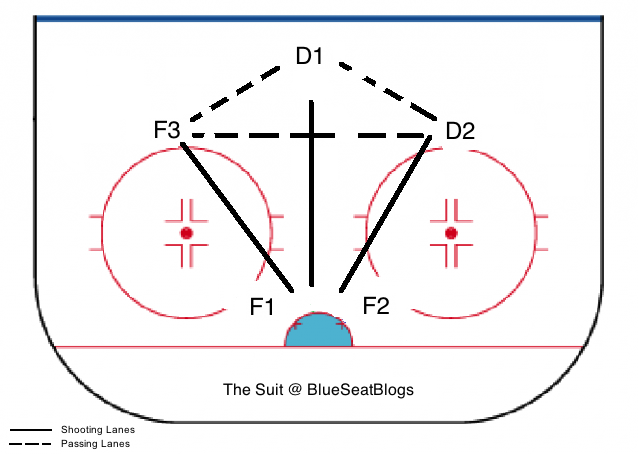
The most common used PP strategy is the Umbrella, which sets up three players near the blueline forming a high triangle and two players low in the slot parallel to the goal line – please note, some coaches stack those two low forwards.
The idea here is to get the puck to the middle of the ice for hard blasts from the point. Secondary objectives include passing options at the half-boards, or to one of the other point players for shots. The responsibilities of the low players are to set up screens/deflections and to get to the net for rebounds.
What I like about this strategy is that it aims to outnumber penalty killers in the high slot. This theoretically should give our defensemen and the high forward a chance to keep the puck in the zone for extended zone time. It also helps to prevent shorthanded breaks.
When this power play is firing on all cylinders, the low forwards will often criss-cross each other just as the shots are coming from the points. Also, the three high players will often rotate spots to pull apart the PK coverage. It’s critical that those high players get pucks to the net.
More after the jump…
The Overload / 1-2-2:
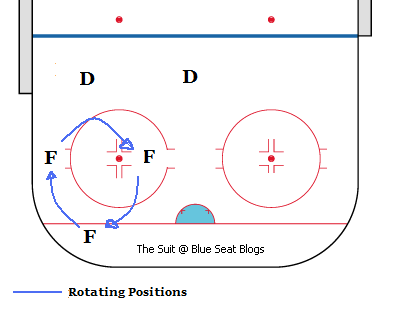
The overload is the main setup we saw during the Jagr/Renney years and is sometimes used by other skilled (aka “finesse”) teams. This formation was popular pre-lockout, but has become less used in recent years.
As you can see from the image, the Overload aims to outnumber the other team along the half boards, thus creating a lot of three on two scenarios. The idea is to constantly cycle the puck and create a lot of movement down low, which causes defensive breakdowns.
The play usually starts along the half boards. One forward supports from below the goal line on the strong side and the other forward gets open in the mid slot on the weak side. The defensemen support from the blue line and are looking to drop in behind coverage.
The problem with this setup, as we saw during the Renney/Jagr years, is that the emphasis is to create quality scoring chances and not as many shots on net as possible. If you can’t get that flow going, the result is fewer shots and players cycling just for the sake of cycling. When that happens, fans tend to lose patience.
The 1-3-1:
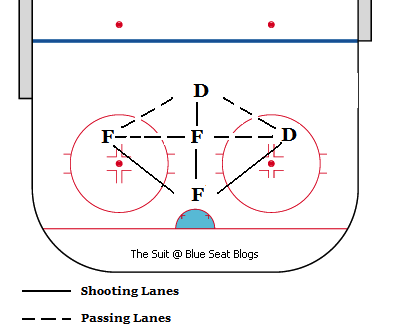
The 1-3-1 power play is a strategy that started in Europe, but is going to become the next big thing in the NHL real soon. In 2010-11, the Lightning were the first team to really showcase it consistently in the NHL and teams had a hard time defending against it.
As you can see from this image, this strategy creates four triangles to pass around and take one-timer shots. You can also QB this setup from four different areas (either half boards, the point, or below the goal line). This system forces the defense to focus on the middle players causing the PK to shrink. As a result, it can be very, very effective.
The problem with the 1-3-1 is that every player must be extremely skilled with the puck. With only one player at the blueline, you’re also leaving the defense completely exposed. The Lightning are able to pull it off because they have a bevy of elite attackers who can pressure the puck, take one-timers, and can back check like hell if there is a turnover on the blueline.
The Spread:
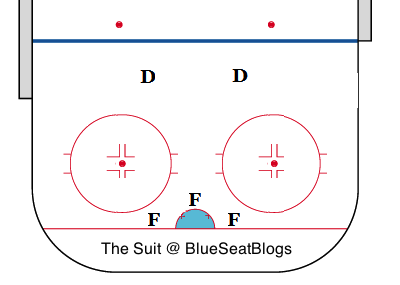
The last strategy is the Spread (or the 2-1-2) setup. The aim of the Spread is to overrun the slot with forwards and outnumber penalty killers down low.
This setup creates problems for the PK because it causes point players to abandon defending the blueline, which allows your d-men to come in for one-timers. On the other hand, if a penalty killer moves to defend a point player, then it can leave someone open in the slot for a backdoor play.
The Spread is typically used in 5 on 3 scenarios, but some teams with bigger powerforwards use this setup on 5 on 4’s since they can out-muscle defenders in the slot and crash the net looking for dirty goals.
While all of these power play setups have their own strengths and weaknesses, the idea of each strategy is to pull apart coverage and create odd-man opportunities. All of these setups require puck and personnel movement, they just do so in different ways and cater to different types of players. So that’s power plays in a nutshell. Next up we’ll tackle penalty killing strategies.
Share:
More About:Analysis Hockey Tactics